
Fish in space? Out-of-this-world faculty and student research
March 16, 2026 / First and Last Name
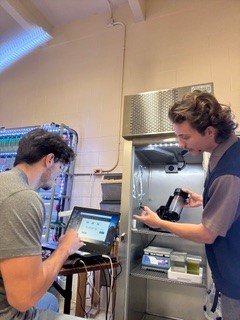
Miguel Zyniewicz (left) and Nathan South (right) with the miniature life support system and microgravity simulator (in article).
No, it’s not a “The Muppet Show” episode—Dr. Sherri Emer’s students research the effects of microgravity on fish and rodent tissues after
simulated and actual microgravity exposure in the lab or aboard the ISS. 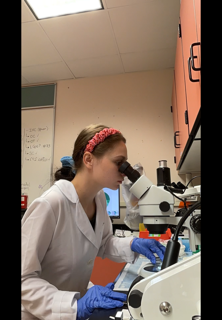
Sage Cohen processing spaceflight mouse brains.
Studying rat brains from a 1985 Challenger mission, student Elizabeth Niles explains, “The presence of immunoreactivity for specific markers in flight rats underscores the potential of these older specimens for unraveling the neurological consequences of spaceflight.”
Elizabeth and fellow students Nathan South, Sage Cohen, and Miguel Znyiewicz will present at the American Society for Gravitational and Space Research Conference, a forum for scientists and engineers who share groundbreaking research with far-reaching impact.
The CAS SELF awards provide experiential learning for students to connect the knowledge learned in their majors to practical, real-world situations.
An FGCU partnership has helped launch them: the College of Arts & Sciences (CAS), Honors College, Office of Scholarly Innovation and Student Research, and Whitaker Institute, along with Travel and Procurement staff Joseph Malu, Demica Mattia, and Brooke Niarchos. Interim Associate Dean and Professor of Chemistry Dr. Greg McManus noted that the CAS Student Experiential Learning Fund (CAS SELF) awards “provide experiential learning for students” to “connect the knowledge learned in their majors to practical, real-world situations.”
Dr. Emer praises these “great resume-building experiences,” calling them “an opportunity to showcase outside-of-the-box approaches to the unique problems of space exploration, strengthen NACE-identified competencies, and have broader impacts that extend beyond this world.”
Share Post


